Table of contents
Traditional booth visualization methods
Before AI, contextualizing a booth relied on two main methods: Photoshop compositing and full 3D rendering. Each has advantages but also significant limitations in terms of time, cost, and required skills.
Photoshop compositing requires a skilled graphic designer who cuts out the booth render, adjusts perspective, harmonizes colors and lighting, then integrates everything into an exhibition hall photo. Expect 2 to 8 hours of work for a quality result.
Full 3D rendering: powerful but heavy
Full 3D rendering involves modeling not only the booth but also its environment: the hall, aisles, neighboring stands, visitors. The result is often impressive but the process is extremely time-consuming.
An experienced 3D modeler needs several days to create a complete scene. The cost can reach several thousand euros, which is only justified for large-scale projects.
AI visualization: speed and accessibility
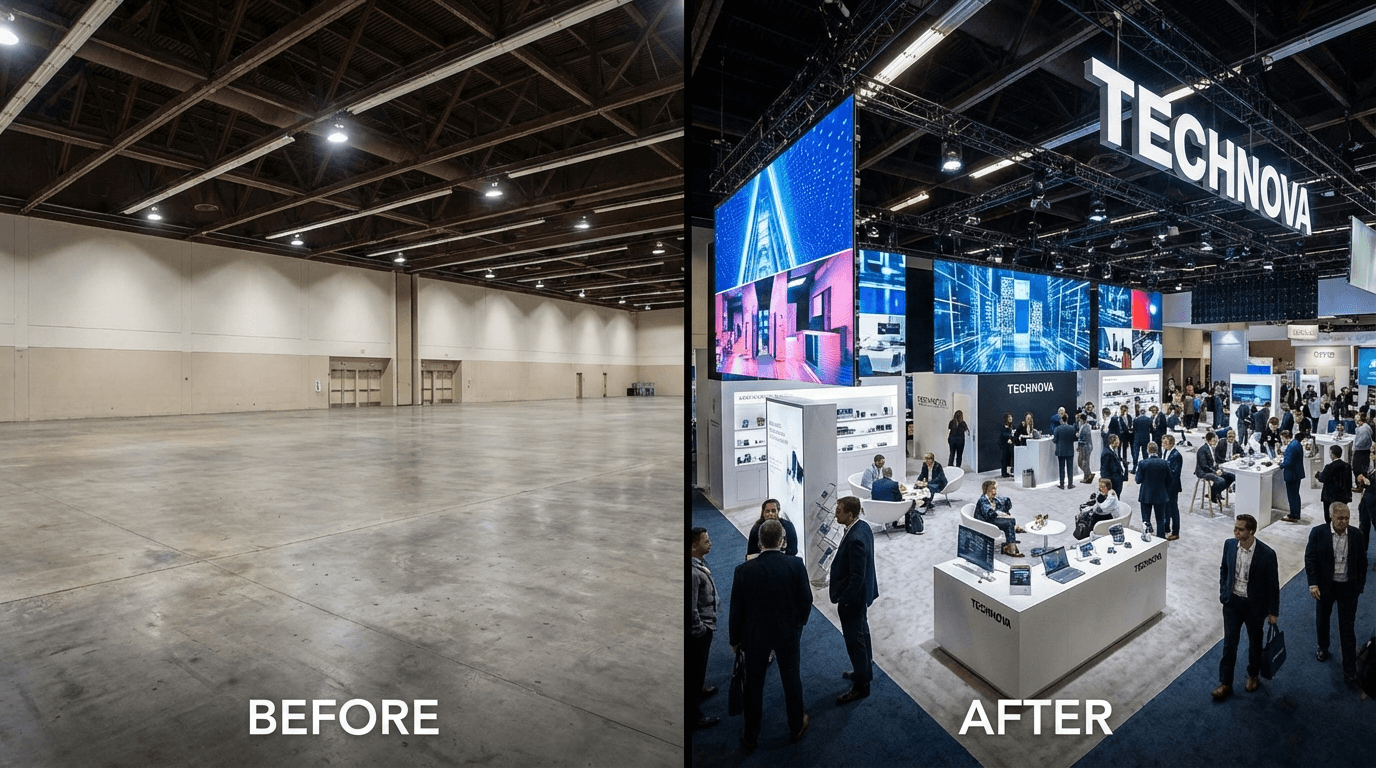
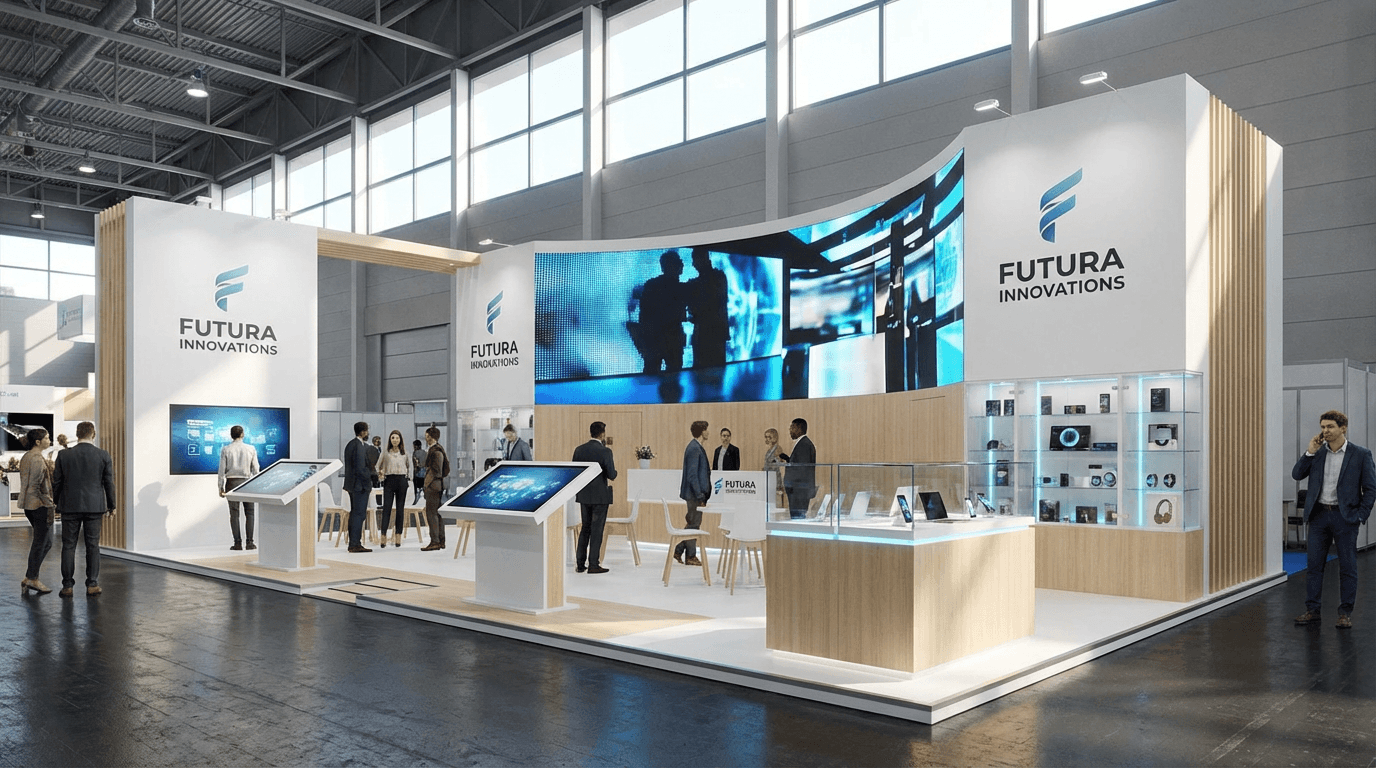
Our approach combines the best of both worlds. You provide only the 3D render of your booth (which you already have), and AI handles integration into a realistic context.
The process takes less than 30 seconds. The cost is a few credits. And the result is photorealistic enough to convince a client in a sales meeting.
Detailed comparison
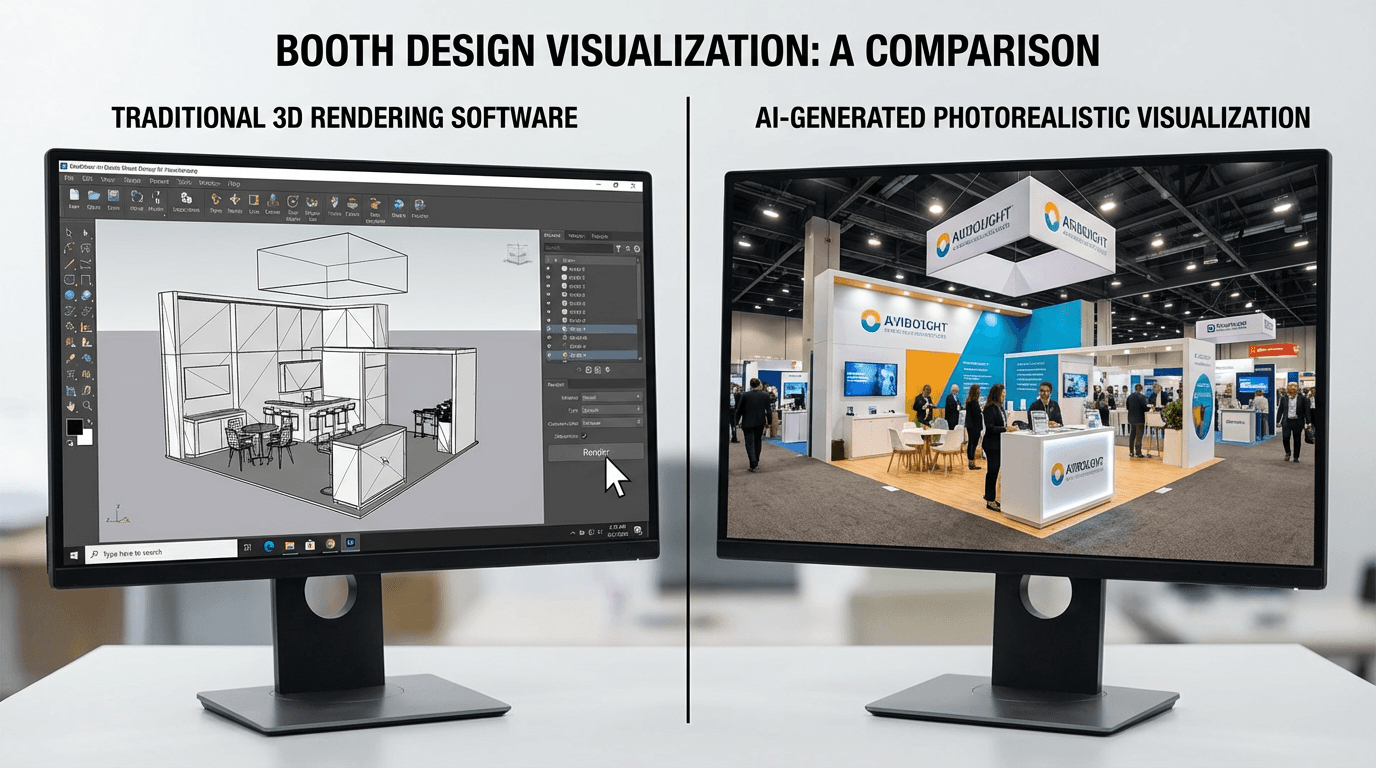
Here is a point-by-point comparison of the three methods:
- Production time: Photoshop 2-8h, full 3D 2-5 days, AI under 30 seconds
- Cost per visualization: Photoshop 150-500 EUR, full 3D 1000-5000 EUR, AI about 1.35 EUR
- Required skills: Photoshop and 3D need a specialist, AI is accessible to everyone
- Number of variants: Photoshop and 3D limit iterations by cost, AI enables dozens of variants
- Maximum quality: full 3D rendering remains superior in raw quality, but AI suffices for 90% of use cases
When to choose which method
Each method has its niche. AI is ideal for design phases, sales presentations, and rapid iterations. It covers the vast majority of needs for booth builders and event agencies.
Full 3D rendering remains relevant for flagship projects where the final visual will be used in large-format printing or advertising campaigns. Photoshop compositing retains its value for very specific retouching impossible to achieve with AI.
The hybrid approach
Many professionals adopt a hybrid approach. They use AI for the design and client validation phases (rapid and inexpensive iterations), then commission a full 3D render for the final visual of the approved project.
This combination optimizes the quality/cost ratio: AI accelerates the early stages and traditional rendering ensures final quality. The time and budget savings during the design phase easily fund the higher-quality final render.